

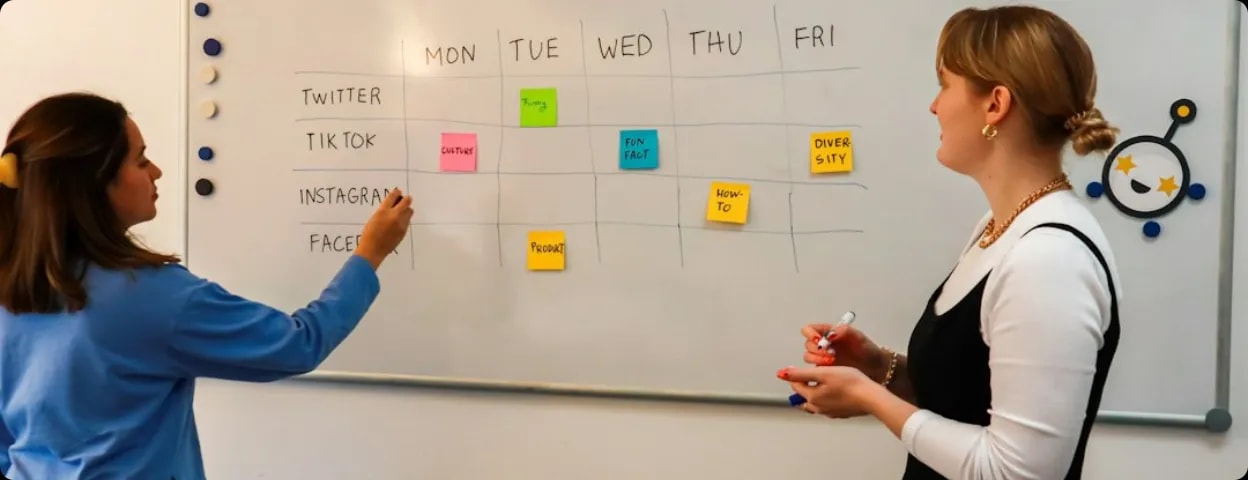
Work rarely slows down because a team has run out of ideas. More often, it slows because priorities are scattered, decisions live in different places and the next person is waiting for context.
A shared weekly rhythm creates a few reliable moments to reconnect. It gives people room to focus while making progress visible to everyone who depends on it.
Keep decisions close to the work
A decision made in a meeting can disappear as soon as the call ends. Capture the choice, the reason behind it and the person who needs to act next in the project where the work lives.
A short written update is often enough: here is what changed, here is why, and here is the next step. Your teammates can catch up in their own time, and someone joining the project next month can understand how you got here.
“A good rhythm makes the next
step clear, without filling every hour.”
Make every handoff explicit
Most handoff problems begin with an assumption. One person believes the work is ready; another is waiting for a brief, a review or a missing file. Before passing something on, make the next action unmistakable.
Name the next owner. Link the latest version. Explain what is ready, what is still open and when feedback is useful. Keep the conversation attached to the task so that context moves with the work instead of staying in a private message.
Close the week with a useful review
Set aside a little time to look at what moved, what stalled and what you learned. A review should help the next week run better. It does not need to become a report on every minute of the last one.
Celebrate a finished outcome, identify one recurring blocker and choose one adjustment to try. Carry unfinished priorities forward deliberately rather than letting them accumulate. Over time, these small improvements build a rhythm that your team can rely on.
A simple rhythm to try
- Monday · Agree on the outcomes that matter.
- Midweek · Share decisions and unblock handoffs.
- Friday · Review progress and choose one improvement.
Start with the smallest version that helps your team. Keep what creates clarity, change what creates friction, and let the rhythm evolve with the people doing the work.
Teamwork · Planning · Connected work